
Paying for home care
Home care services aren’t usually free, and are paid for by:-
- The person that uses the service or their loved ones;
- A local authority (such as a council or NHS Trust).

Paying Privately for Home Care
Paying privately (also called self-funding) means you or your loved one uses personal savings and/ or income (such as a pension) to pay a provider directly for home care.
This option is generally for those who are not eligible for funding by a local authority (because of assets and savings greater than £23,250), or those who want to have control over their care options.
With this option you are free to choose the care provider that you want to use.
The Costs of Private Home Care
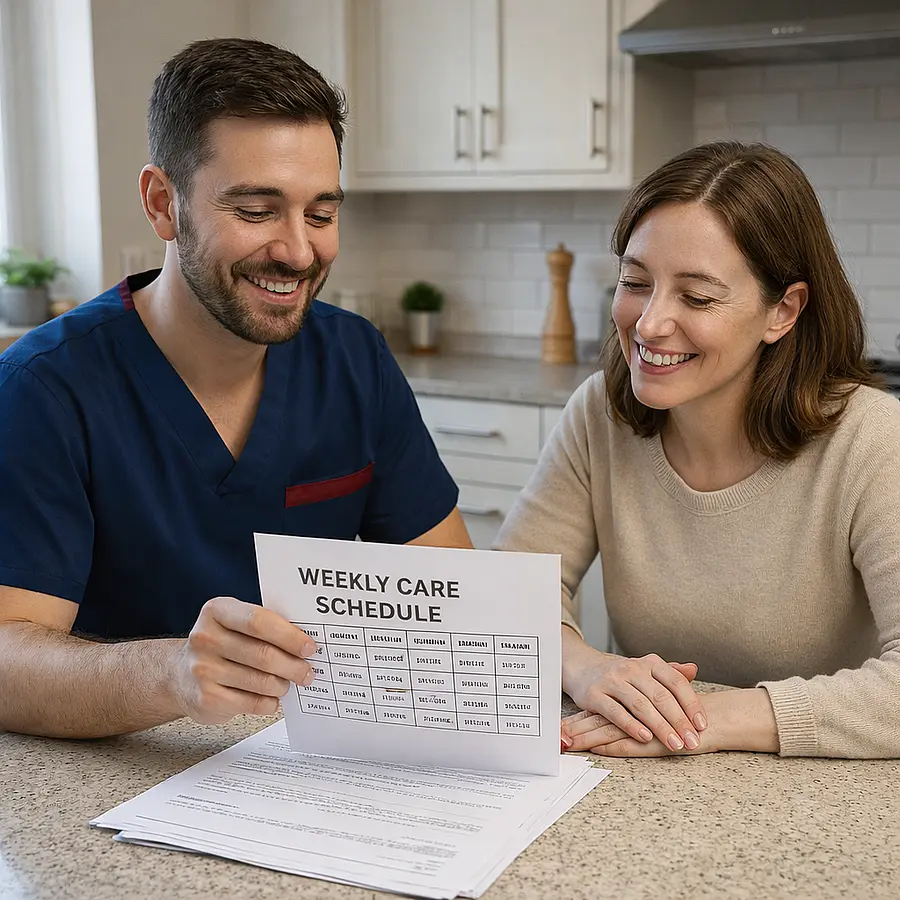
Care costs depend on the care needs, the care visit duration, as well as when and where the care takes place.
Our care costs start at £25 per-hour, and care visits can be arranged in 15 minute increments. Travel time is covered in the cost and travel time to and from the location is not deducted from the care visit time (if you need us for 1 hour that's the face-to-face time your get), there are also no hidden fees or extra charges for things like travel, admin, or PPE.

Full Funding by a Local Authority
If the council or other local authority fully funds your care, they cover the cost based on you or your loved ones' assessed needs.
Fully funded care is only available following a care needs assessment, which includes a financial assessment (or means test).
Generally, if assets (including most investments and savings, but excluding any property) for the person needing care are less than £14,250 they should qualify for full funding.
With this option the council or local authority will choose the care provider that will be used, and will pay the provider directly.

Partial Funding by a Local Authority
When care is part-funded, the council or other local authority pays for a portion of the care costs and you or your loved one have to pay the rest.
Partially funded care is only available following a care needs assessment, which includes a financial assessment (or means test).
Generally, if assets (including most investments and savings, but excluding any property) for the person needing care are between £14,250 and £23,250 they should qualify for partial funding.
With this option the council or local authority will choose the care provider that will be used, and will pay their portion directly to the provider, your or your loved one then pay the difference.

Asking for Direct Payments
If you or your loved one are eligible for funding (either in full or in part) by a local authority you can request the funding amount to be paid to you or your loved one directly.
With this option you choose and arrange the care provider that you want to use, which you or your loved one would then pay for using all or part of the direct payment you received.

How to access funding from a local authority
To get help from a local council, you or your loved one must first ask them for a care needs assessment. This assessment looks at what care needs you or your loved ones' have and the sort of care services that may help meet the needs.
The care needs assessment also looks at whether you or your loved ones' are eligible for help from the council, based on the level of need. This is called having 'eligible' care needs.
The care needs assessment will also include a financial assessment (or means test).

Getting a Care needs assessment
Everyone is entitled to a free care needs assessment.
You can ask your council for a care needs assessment or, with your permission, your carer, GP or district nurse can refer you for an assessment on your behalf.

Support following a hospital discharge
If you or a loved one is being discharged from hospital, there should be a care needs assessment done beforehand to work out what care services may be needed following the discharge. This may include a period of rehabilitation to help with recovery at home.

Other Financial Support
Make sure you’re claiming all the benefits you’re entitled to.
- Attendance Allowance is a benefit for people over State Pension age who need extra help to stay independent at home, due to an illness or disability.
- If you’re under State Pension age, you may be eligible for Personal Independence Payment (PIP) instead.
- If you have a carer, they could be eligible for Carer’s Allowance.
These benefits aren’t means-tested (although with Carer's Allowance you can't earn more than a set amount per week) so they don't take into account your income and savings.